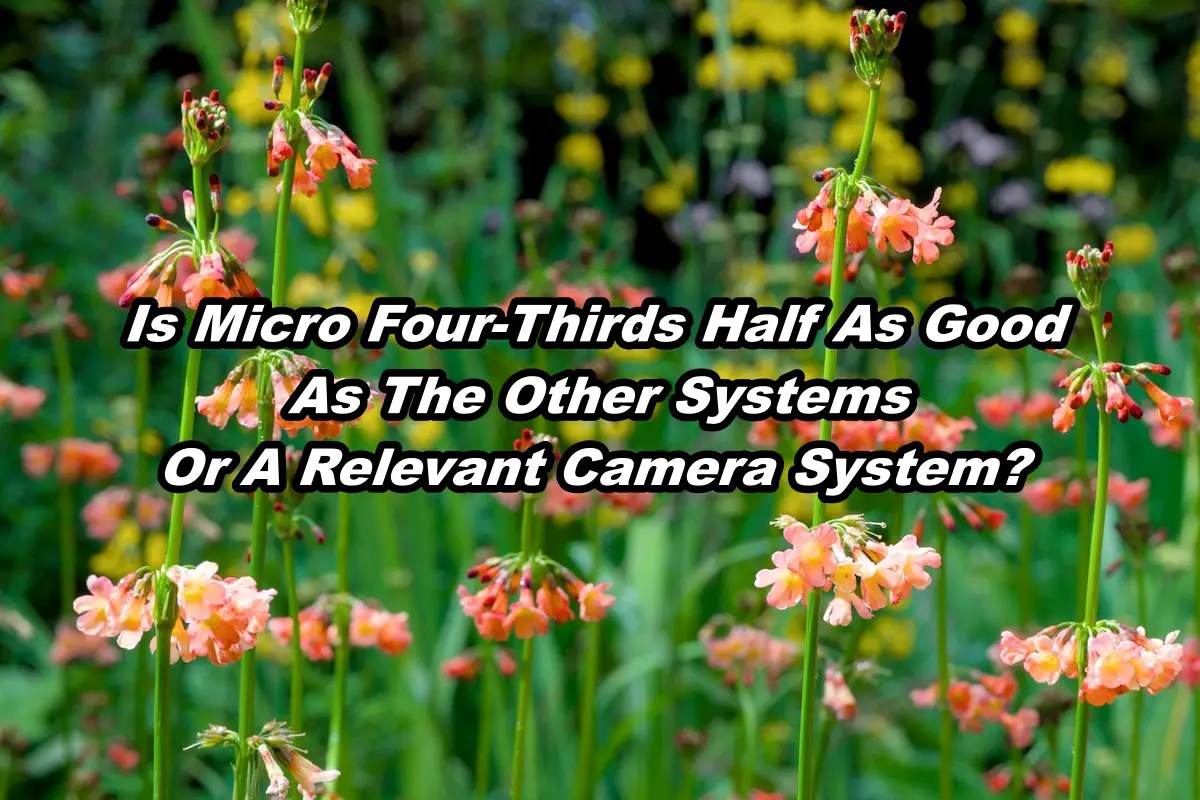
In the world of modern digital photography, where bigger is better is often the loudest mantra with professionals and experienced amateurs alike, Micro four-thirds cameras remain the defiant underdog that just will not die. Developed by Olympus (now OM System) and Panasonic, this mirrorless standard uses a sensor size exactly half that of a 35mm full-frame sensor. But is it only half as good a system? Let us find out…
While many tech-spec dismiss it for its smaller sensor, the micro four-thirds system has cultivated a devoted, almost cult-like following. In 2026, the system isn’t just surviving; it’s thriving among specific groups of creators who prioritise agility and innovation over raw sensor real estate.
What Makes Micro Four-Thirds Different?
To understand the users, you must understand the gear. The Micro Four Thirds system is built on a 2.0x crop factor. This means a 300mm lens on a M43 camera provides the same reach as a massive 600mm lens on a full-frame body! But at a fraction of the size and cost!
Key Advantages:
- Size & Weight: You can fit a micro four thirds kit (body and three lenses) into a small messenger bag (this can be done with APS-C and even some full frame cameras, but not so easily!)
- Class-Leading IBIS: In-Body Image Stabilization in micro four-thirds cameras had been legendary, often allowing for multi-second handheld shots that would require a tripod on other systems, and it is only now that the likes of Nikon, Sony and Canon are really catching up.
- Computational Brilliance: Because the sensors are smaller and easier to read quickly, brands like OM System lead the way in features like LiveND (digital neutral density filters) and Handheld High-Res modes, which is a fantastic plus for artistic use with these cameras.
Who is the usual Micro Four Thirds Photographer?
I know quite a lot of micro four-third camera users, and there is definitely a pattern with who uses these cameras over the other camera systems, and it is all down to the uniqueness of its small sensor.
1. Bird and Wildlife Amateur Enthusiasts
If you’ve ever trekked five miles into a forest carrying a 600mm f/4 full-frame lens, you know the literal pain of heavy gear (and I know that feeling with my Tamron 150-500mm lens!). Wildlife photographers are perhaps the biggest M43 advocates for this very reason, and I do not blame them!
Seeing my friends and colleagues pull out the equivalent of 600mm and it is the size of my Nikkor Z24-70mm lens is a real eye opener! Yes, micro four-thirds lenses can really be that small (as a side-note, I have a couple of birding friends who have very large micro four-thirds lenses that are a similar size to my 150-500mm, but they have the equivalent of 1200mm reach with their lens!)
2. The Solo Video Creator & Vlogger
Panasonic’s GH series (like the GH6 and the recent GH7) has long been the “Swiss Army Knife” of video. Many videographers use micro four-third cameras for video as they are small, light and give amazing results.
3. The Adventure & Travel Photographer
For those who just need a small camera with a long reach, micro four-thirds cameras and lenses just make sense when you want better quality than your mobile phone or your old bridge camera. It may be a smaller sensor compared to APS-C and full frame, but it is HUGE compared to those cameras.
4. The Macro Specialist
In macro photography, depth of field is paper-thin and the small sensor on these cameras mean that you will not struggle as much as full frame and APS-C cameras.
5. People who just want a lightweight experience
This is quite a big one (excuse the pun), in that, when talking to the numerous people who use micro four-thirds cameras, it is often all about the size and the weight of the system. Quite often, no other reason than that! I myself used my Olympus EPL-8 because it was small and light, and fitted with the 17mm prime lens, was an almost pocketable 35mm (equiv) walk around camera. Many (almost always) times, it is also their 2nd camera system, something they take out with them when they can not be bothered (or simply do not need) with their more expensive, heavier kits. It makes sense, as you do not always need to have your full frame kit with you (hence I often use smaller sensor cameras!)
Conclusion
Micro Four Thirds is not for the professional photographer who exclusively shoots dark wedding receptions or dark situations, or wants the thinnest possible “bokeh” for portraits. Micro four-thirds is not for the photographer who needs the dynamic range and other necessities that full frame offer. It is for the active creator, the person who views their camera as a tool to be used in the wild, on the move, and in the thick of the action.
Micro four-thirds excels in environments where extra reach is needed, it excels in providing an ecosystem that is small and light, so that you think about the photograph more than carrying the equipment. For those that use it, it more than fulfils their needs (as I said many times, we all have different needs), and if you are only ever posting on social media or your website, no one will ever know what camera it is that you used anyway!
Micro four-thirds cameras are not half as good as APS-C or full frame camera systems. They are a different tool for a different job that co-exists for those who need the advantages of micro four-thirds.
You can find all the latest articles and blogs on my homepage here.
My main photography social media page is my Facebook One Camera One Lens Photography page.
Nikon Recipes for the Z system can be found here.
You can find a complete list of my gear here.
 One Camera One Lens Photography
Hi Mark, thanks for sharing this. I enjoyed reading your perspective on the system. You make some solid points about where Micro Four Thirds fits in today’s landscape, especially regarding size, reach and usability in the field. I hope you don’t mind me adding a slightly different perspective here and there.
From my experience, Micro Four Thirds is also very much used at a professional level, including in wildlife and nature photography. There are quite a few working photographers who earn their income with it, and many of them are easy to find online through their portfolios and published client work.
I think part of the ongoing debate often comes down to perception – the long-standing idea that “bigger must be better” – and the way online discussions tend to amplify that view. For a while, some even assumed the system would quietly disappear, especially around the OM System transition. That hasn’t really been the case. If anything, the system continues to evolve and maintain a strong presence within its niche.
In the end, I’ve never seen it as a matter of one format being better than another. Different tools suit different needs, and that’s really the point. “Professional” seems to be more about how and why the gear is used than about sensor size alone.
Appreciate you taking the time to lay out your thoughts on it.
Have a great weekend with the family,
Marc.
LikeLiked by 1 person
Thank you Marc, yes, I believe I addressed all our most of those things, and in tomorrow’s follow-up article, it will be touched on. There are always professional photographers who use cameras of all different sorts, heck, there are even some who use film cameras for wildlife. It’s not the norm, but it does happen.
I think the whole series has been very fair and accurate, and tomorrow is looking at some of the great feedback from the series and the misunderstanding by some people.
Enjoy your weekend.
LikeLiked by 1 person
Another wonderful article, Mark! Your information is very useful!
LikeLiked by 1 person
Thank you very much, I appreciate it.
LikeLiked by 1 person