
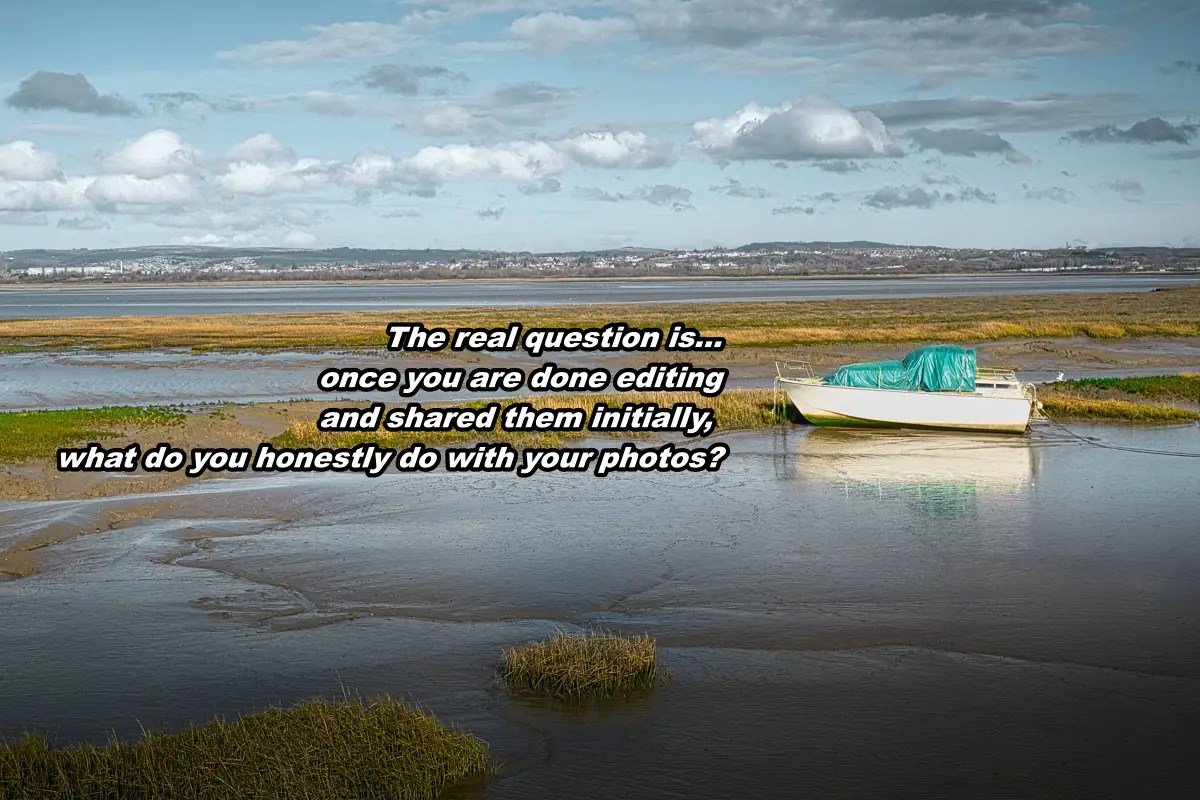
There is no greater feeling than completing your image after editing (be it editing a raw file, or just cropping and straightening a jpeg). The first thing you do over the next few days is share your wonderful new images to your Facebook account, Instagram etc or your website for others to enjoy and for you to show off your latest masterpiece.
But then what? Maybe a few of you will use your favourite image from that session in a photography club competition, maybe you’ll use you photo as a computer screen wallpaper, and a few of you may not even do that, and that sharing was the end of your images life and it’s now on one of your hard drives sitting there in the hell that we know as the digital image graveyard, in the thought that one day you might do something more with the image. The reality is, it’s the image graveyard for a reason.
For a few of us (and after numbers polls and conversations over the years in photography circles, it IS a few of us), we will print out our images, either to hang on our walls or to keep the photographs in well curated photo albums.
But beyond that, beyond the initial sharing on social media, the other opportunities and the printing, what do you do?
It is a question which a lot of photographers do not like to talk about, because it is admitting that photography is, for the most part, a disposable art form, where in reality, after the initial burst of excitement, your images are generally gone and forgotten.
Of course, there is one type of photography that many just like to dismiss as snapshots. And for many, they will look at, share, print and reminisce over those snapshot images for many years. Those snapshots are the photos you take of your family, friends, pets and general unprocessed phone images of the holiday places you’ve visited. But of course, there is a reason for these photos getting the love compared to your highly crafted masterpieces… Memories and life milestones.
You’ll cherish that photo of your new-born, your friend eating a huge cake sitting opposite you, your dog covered in mud, your parents in a photo they’ve handed down to you from when they first met. Your memories, and the memories of others around you just mean so much more than you’ll ever think they do at the time you just pointed your camera or phone and snapped.
Although your main camera images are generally sitting there in the digital graveyard, do not worry too much. You are not alone in doing nothing in the long term with those images, because in reality, the well thought out compositions, the highly crafted and edited images you’ve taken hours perfecting, they are the disposable images that you’ve tried to avoid taking all your life, while your snapshots are your real masterpieces (because an important and meaningful image is more than just editing).
So, after reading this, perhaps make time to dip into that digital graveyard of raw and jpeg files a bit more regularly than you do now. Don’t worry about editing those disposable images (use the images in your “Final Edits” folder you no doubt have) , just look at them, maybe do a photo book or two of the oldest images you can find and remember… You are not alone, but you had fun at the time. There’s nothing wrong in admitting your “serious” photography is really not as important as your snapshots.
You can find all the latest articles and blogs on my homepage here.
My main photography social media page is my Facebook One Camera One Lens Photography page.
Nikon Recipes for the Z system can be found here.
You can find a complete list of my gear here.
My film preservation website “Our Life On Film” can be found here.
 One Camera One Lens Photography
Hey Mark,
I revisit old RAW files regularly, not out of nostalgia but because time, experience and better tools let me give those images a second life. What struck me most in your article is the word memory. For me, that’s where IPTC metadata becomes crucial: embedding the context and story while it’s still fresh, so images don’t just survive on a hard drive, but remain findable, meaningful, and alive years later.
Interesting article, and definitely something many photographers should take time to reflect on.
Have a great day,
Marc
LikeLiked by 1 person
Thank you Marc.
LikeLike
But other than editing, what do you actually DO with them?
LikeLiked by 1 person
Luckily, my old and once well-thought-out file naming is still just good enough to trigger memories when I dig through my archive – and that’s mainly what I do with them, besides re-editing.
When I compare this to my long analogue years, it’s actually not that different. Negatives were pure storage; I rarely did anything with them. Prints in albums, sometimes loose in envelopes, were pulled out from time to time – usually together with my wife – simply to revisit old memories.
In that sense, digitally, it’s really the same thing now.
LikeLiked by 1 person
Good question Mark. I used to print them all, until my photo albums over ran my book case. Since the age of digital, I put together Corel Pinnacle photo/video shows with music and captions, which we can watch from time to time, sharing with friends and family, only if THEY ask. We also do photo cards for every occasion, both hard copy and digital and send them out throughout the year. But, you are right, there are so many images, we often forget what we have and need to go back to relive our history. Cheers. Allan
LikeLiked by 1 person
Thank you Allan
LikeLiked by 1 person
I share them.
LikeLiked by 1 person
Thank you 🙏
LikeLike
And keep them for later, when I’m old and not so mobile anymore..
LikeLiked by 1 person